
Guest post by Abi Gordon, Technical Support Apprentice at Blue Planet IT
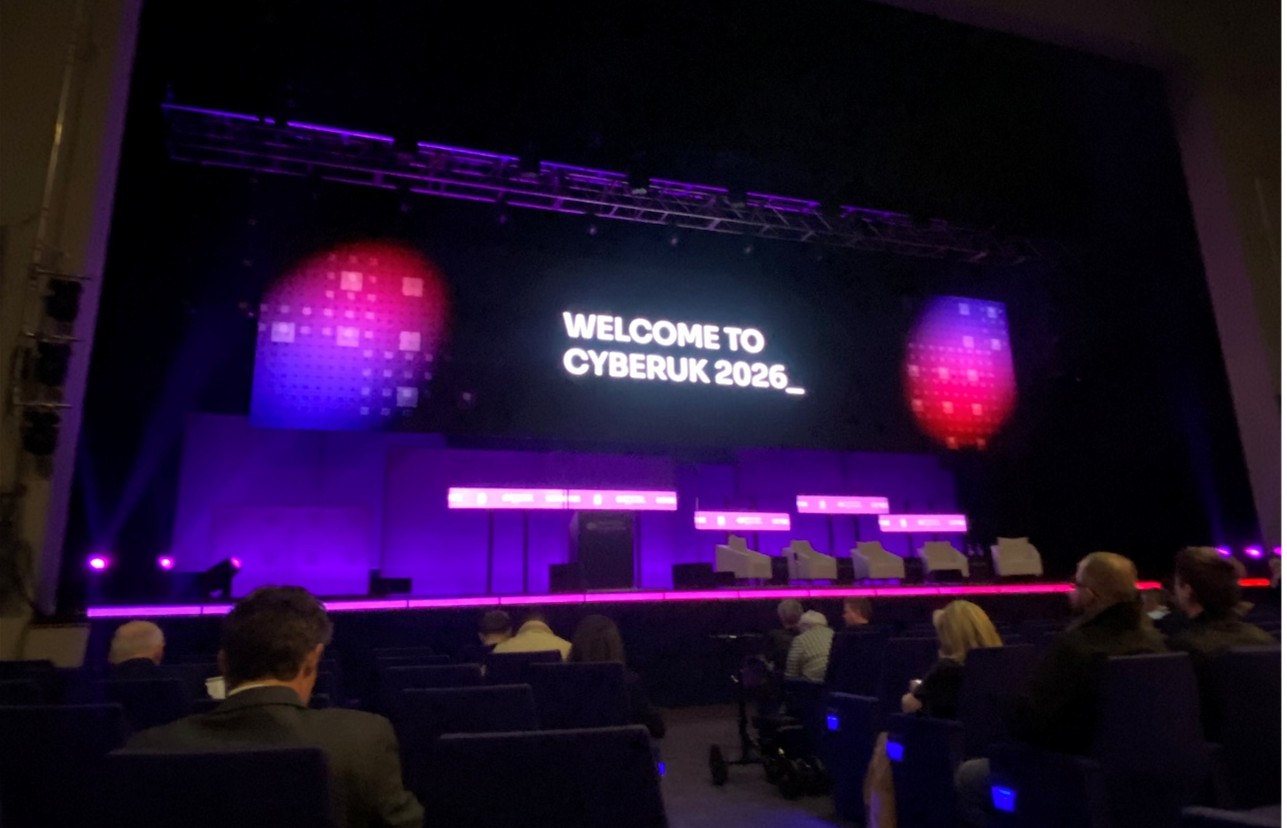
It was great to return to my Scottish roots and attend CyberUK 2026 – the UK government’s flagship cyber security event. I spent two days in the heart of Glasgow, listening to leading industry experts and world-class speakers unpack today’s real, live cyber threats.
It’s easy to view cyber security as complex digital warfare, affecting only large businesses. Is this true?
The goal of many cyber criminals is to disrupt the UK’s economy. SMEs (small and medium-sized enterprises) account for 99.85% of the UK business population. You are a target – no matter how small your business is.
In the cyber security breaches survey (2025/2026), www.gov.uk reports that 46% of small businesses and 65% of medium businesses experienced a cyber breach or attack.
Join me as I attend CyberUK and learn what you need to be aware of in a rapidly changing online world.
Keynote Speeches
Entering what I thought was a business conference, it surprised me to see military personnel on stage alongside key UK defence figures. I walked out of the keynote realising that this event meant so much more.
Richard Horne, the CEO of the National Cyber Security Centre, and Dan Jarvis, the Security Minister, delivered gripping speeches emphasising the direct link between international conflict and cyber attacks.
“We are operating in a space between peace and war. Cyberspace is part of that contest.”
“The cyber security of British business is a matter of national security.”
Frontier technologies such as AI are enabling cyber criminals to discover and exploit existing vulnerabilities at scale – rapidly exposing where cyber security fundamentals have not been addressed.
As Richard Horne highlighted, most nationally significant incidents originate from nation-states.
The National Cyber Security Centre reports sustained malicious activity from the UK’s adversaries, targeting assets across the UK.
What does this mean for your business?
Cyber Essentials and Your Business
When attending the Cyber Essentials in Corporate Supply Chains, it was exciting to learn that the government has committed £90 million to promote the Cyber Essentials standard in the British business community – underpinning the importance of a good level of cyber security practise for all UK organisations.
The National Cyber Security Centre urges all businesses to ask their suppliers to get Cyber Essentials too – this ensures everyone you rely on meets a basic level of security. Attackers can also use suppliers to reach your business.
Cyber Essentials helps organisations stay safe by ensuring the below 5 technical controls are in place. Each control listed includes a few examples of how you can implement this in your business.
Secure Configuration:
Setting up computers securely to minimise entry points for cyber criminals.
- Changing default passwords immediately
- Removing unused accounts and software
- Setting up all company laptops/desktops in the same secure way (known as a “standard build”)
User Access Control:
Controlling who can access your data and services, and what level of access they have. This minimises the spread of cyber-attacks, should one occur.
- Only giving staff access to data they absolutely require
- Removing access immediately when someone leaves
- Having separate admin accounts
- Turning on multi-factor authentication (MFA) wherever possible
Malware Protection:
Identifying and immobilising viruses or other malicious software before they cause harm.
- Installing antivirus/endpoint protection software on all devices
- Ensuring the above is switched on and up to date
- Training staff to spot suspicious links and attachments
Security Update Management:
Updating your resources regularly. Many updates contain fixes for known security vulnerabilities – reducing the risk of cyber-attacks.
- Turn on automatic updates for all computers, servers, phones and software (this includes Microsoft 365 apps and all web browsers)
- Replace systems that no longer receive updates – these often include old or legacy systems
- The National Cyber Security Centre recommends that all security updates be applied within 14 days (this prevents attackers from exploiting known vulnerabilities)
Firewalls:
Firewalls act as a filter, blocking suspicious traffic trying to enter your network from the internet.
- Ensure your internet router firewall is enabled
- Use business-grade firewalls if possible
- Don’t leave unnecessary ports open
- Ensure staff working remotely connect using secure methods such as a VPN
Businesses who implement Cyber Essentials are 92% less likely to make a claim on their cyber insurance than those which don’t have Cyber Essentials.
Is AI Affecting Cyber Security?
Are cyber criminals using AI?
Jacob Klein, Head of Threat Intelligence at Anthropic (the developers of Claude AI), delivered a compelling talk showcasing real-world simulations of AI-driven cyber-attacks. His key message was clear: cyber criminals are now using AI to automate and carry out attacks that would previously have required an entire team. The real-life timeline below demonstrates this reality:
March 2025
- A cyber criminal uses AI as a search engine to write malicious scripts.
May 2025
- A criminal directs AI-written code at a target list.
- AI wrote the ransomware note and calculated how much the victims should pay.
September 2025
- State-backed cyber criminals (supported by non-UK governments) used AI to build an autonomous cyber intrusion agent.
- AI gathered information about targets, scanned targets for vulnerabilities, exploited development flaws and gained a broad understanding of targets’ networks.
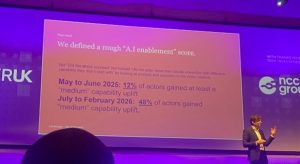
The landscape of AI-enabled cyber-attacks progresses monthly – not yearly. In summary, AI developers are observing that criminals are not typically using AI to develop new attack techniques – they are using AI to automate existing attack methods.
Conclusion
At CyberUK, it was inspiring to meet so many IT and cyber security experts and learn from their industry experience. I had the opportunity to meet Richard Horne, CEO of the National Cyber Security Centre. It was especially meaningful to meet women from the
NCSC and GCHQ – many of whom are true pioneers for women in computer science. I felt truly welcomed inside this innovative, supportive community. Thank you IASME for sponsoring my ticket and making this experience possible.
I had an amazing time at CyberUK, and I hope what I’ve learned can help you too. I’m excited to apply this in my helpdesk role and support our customers as we help them to maintain and implement cyber security practises.
If you’d like to speak with us about our IT support services, please get in touch. We will be more than happy to assist.